Winter each year brings an increased risk of accidents around the home. Slippery stairs, icy driveways, frozen terraces, or hanging icicles create hazards for both residents and guests. Proper protection against ice on the property is not only a matter of convenience but, above all, responsibility and safety.
In this guide, we present how to effectively secure key elements around the building to significantly minimize the risk of slipping on the driveway and other dangerous situations in winter.
Most Common Winter Hazards Around the House
Icy driveways and paths
Driveways and main access paths to the house are the most susceptible to icing — especially during temperature fluctuations around 0°C, when snow melts and refreezes. This is the main cause of winter injuries. One cannot forget about unexpected morning situations when the driveway turns into an ice rink, causing a stressful situation related to being late, the need to shovel snow, or de-ice the path for the vehicle.
Slippery entrance stairs
Stairs quickly become covered with ice, making them one of the most dangerous places. A fall in such an area can lead to serious injuries.
Icy gutters and icicles
Frozen water in gutters and the formation of icicles pose a threat to those passing underneath and to the roof structure itself if enough snow and ice accumulate.
Frozen water on terraces
Ceramic or granite tiles used as terrace finishes have low traction when icy, which dramatically increases the risk of slipping. Ice also poses a threat to the terrace surface and can cause damage.
Ice Protection — Key Methods to Prevent Accidents
Regular snow removal and clearing slush
This is the foundation that reduces the risk of icing but requires a lot of consistency and is not always
Using sand or gravel
These materials improve traction but do not remove ice. They also require cleaning the surface in spring.
Eco-friendly de-icing agents
An alternative to salt:
- calcium acetate,
- magnesium chloride,
- calcium chloride.
They work more effectively than salt but still need to be applied manually and periodically.
Mechanical anti-slip mats
They can reduce the risk of falling on stairs or terraces, but do not solve the problem of icing the entire surface.
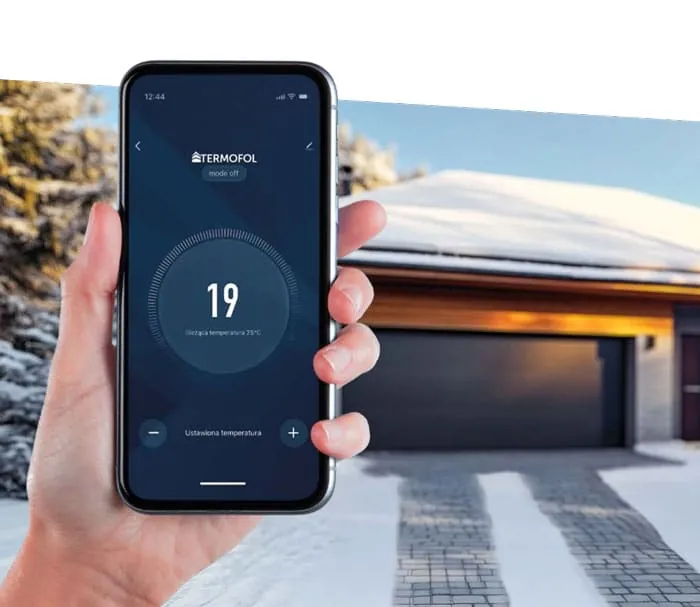
Modern installations of external electric heating are currently one of the most effective methods to ensure complete winter safety around the home.
These systems consist of:
- heating cables installed in gutters, downspouts, and on the roof,
- heating mats installed under the surface of the driveway, stairs, or paths,
- temperature and humidity sensors,
- an automatic weather controller.
Unlike traditional methods — they work preventively, preventing freezing instead of reacting when ice has already formed.
Why Electric Systems Increase Safety in Winter?
Elimination of ice in critical areas
These systems protect particularly dangerous places:
- driveways,
- outdoor stairs,
- access paths to the house,
- garage ramps,
- terraces,
- gutters and downspouts.
Automatic operation
Thanks to moisture and temperature sensors, the system activates only when there is a risk of icing — this means maximum efficiency and minimal costs.
Protection of building infrastructure
No icing also means no damage:
- paving stones,
- concrete slabs,
- gutters and downspouts,
- roof structures.
Minimization of slipping risk on the driveway
The greatest advantage — the system prevents the formation of ice on the surface, which drastically reduces the risk of falls and injuries.
Cost vs. Real Value of Safety
It should be noted that the costs associated with the consequences of winter accidents — from surface damage to injuries of residents — often far exceed the cost of installing an anti-icing system.
External electric heating is a solution:
- durable,
- maintenance-free,
- energy-efficient,
- providing long-term protection.
Compared to traditional methods, this is an investment in real safety for the property, additionally increasing its value.
How to Ensure a Safe Home in Winter?
To effectively reduce the risk of winter accidents around the house, it is worth implementing solutions that work preventively rather than merely reacting to existing icing.
The most important steps are:
- regular snow removal,
- improving surface traction when necessary,
- removing icicles,
- using eco-friendly de-icing methods,
- considering electric anti-icing systems for the driveway, stairs, terraces, and roof.
With appropriate actions, winter safety can be significantly increased, and the risk of slipping on the driveway or stairs can be virtually eliminated.
 +48 12 376 86 00
  Downloads
  biuro@termofol.pl


 Blog Termofol
 Published: December 12, 2025
  Reading time: 4 minutes
 General information