In today's article, we will take a look at one of the most fascinating materials, graphene. What is it and what properties does it have? What applications of graphene are currently being researched and implemented in heating systems? We invite you to read on.
Graphene – what is it and how is it created? Introduction to the topic
Carbon is one of the chemical elements. It is worth noting that it occurs in various structures, called allotropes, such as diamond, graphite, fullerenes, or graphene. Allotropes of carbon is a fascinating topic, and each form has unique properties.
Graphene is a single-layer material made up of carbon atoms arranged in a honeycomb structure. Importantly, it is a form of carbon similar to graphite, but only one atom thick.
The processes of processing graphene, such as delamination, ultrasonication, and plasma treatment, control the breakdown of graphite, creating graphene flakes. Although the delamination method allows for the production of high-quality graphene flakes, it is not suitable for large-scale industrial production. On the other hand, plasma and ultrasonic treatment techniques enable the production of significant amounts of graphene oxide, reduced graphene oxide, and graphene nanoplatelets.
Graphene – properties and applications
The properties of graphene make it a material with enormous potential. Its single-layer structure gives it excellent electrical and thermal conductivity, making it an ideal candidate for applications in various fields, including heating.
What else distinguishes graphene? Properties worth knowing include:
- it has low resistance,
- it exhibits very high electron mobility at room temperature, assuming only scattering on phonons;
- it achieves an electron flow speed equal to 1/300 of the speed of light,
- it is practically transparent – a layer one atom thick absorbs only 2.3% of white light,
- it has over 100 times greater strength than steel of the same thickness, while being flexible enough to be stretched by up to 20% without damage;
- a membrane made of oxidized graphene is impermeable to gases, even helium atoms, while completely allowing water (H2O) to pass through. This opens up the possibility of using graphene for filtration at room temperature, for example, to increase alcohol concentration without the need for traditional distillation or freeze distillation processes.
As a result, the applications of graphene are wide and varied. This form of carbon, as an excellent electrical conductor, is used in the production of fast and efficient electronic circuits. However, this is just the tip of the iceberg, as this element has the potential to transform many aspects of healthcare, construction, and printing. Graphene in medicine is used, for example, for diagnostics or tissue regeneration.
Graphene oxide can serve as an additive to plastics and find applications in polymers reinforced with fiberglass, as well as in concrete, to enhance their strength and thermal conductivity. Furthermore, various forms of graphene materials are suitable for use in protective coatings. The properties and applications of graphene also include printing. Researchers have successfully developed an effective technique for applying graphene to film, using an innovative plate technology that allows for the transfer of high-quality graphene to large surface areas.
Graphene – application in heating systems
The latest application of graphene in heating seems to be an excellent idea, as this allotrope of carbon conducts heat very well. Graphene allows for the creation of flexible heating structures that can easily adapt to the shape of the surfaces they are applied to. This flexibility would allow for more precise and even heating of various areas.
Moreover, graphene in heating allows for faster achievement of the desired temperature. Thanks to its excellent thermal conductivity, graphene-based systems can effectively distribute heat, eliminating the need for prolonged waiting to reach the optimal temperature in a room.
Properties and applications of graphene in heating films – an unfulfilled vision?
The vision of flexible heating films with a graphene matrix that we can place on surfaces of any shape is very attractive and provokes reflection. However, is it true? Already now, on online auctions and in stores, you can find products labeled as heating films with graphene. Unfortunately, questions to the sellers of these devices about the amount of graphene placed on the matrix remain unanswered. Why?
It is nothing more than a marketing gimmick, and Termofol, as an expert in modern heating technologies, can prove this. Just look at the price of the material. Currently, it ranges from 50 to 200 dollars per gram of graphene. One can imagine that the price of a heating film with a graphene matrix would be several times higher than that available, for example, in the Termofol store. For example, we present an offer from one of the online stores for "infrared graphene heating film," which costs 428 zlotys. If there is any graphene in this device at all, it is so little that its presence certainly makes no difference.
Termofol heating systems. Summary
Graphene in Poland has a certain extraordinary charm, as it became the subject of intense media interest a few years ago. Nowadays, many companies specializing in the sale of heating films use the "fame" of this form of the element to promote their products as the most modern and effective.
It is a fact that the application of graphene in heating films is noteworthy, but currently, the price of this raw material is so high that its widespread use becomes simply unprofitable. Therefore, if you are looking for a profitable, convenient, and above all, realistic solution, visit the Termofol heating films store.
 +48 12 376 86 00
  Downloads
  biuro@termofol.pl


 Blog Termofol
 Published: January 13, 2024
  Reading time: 5 minutes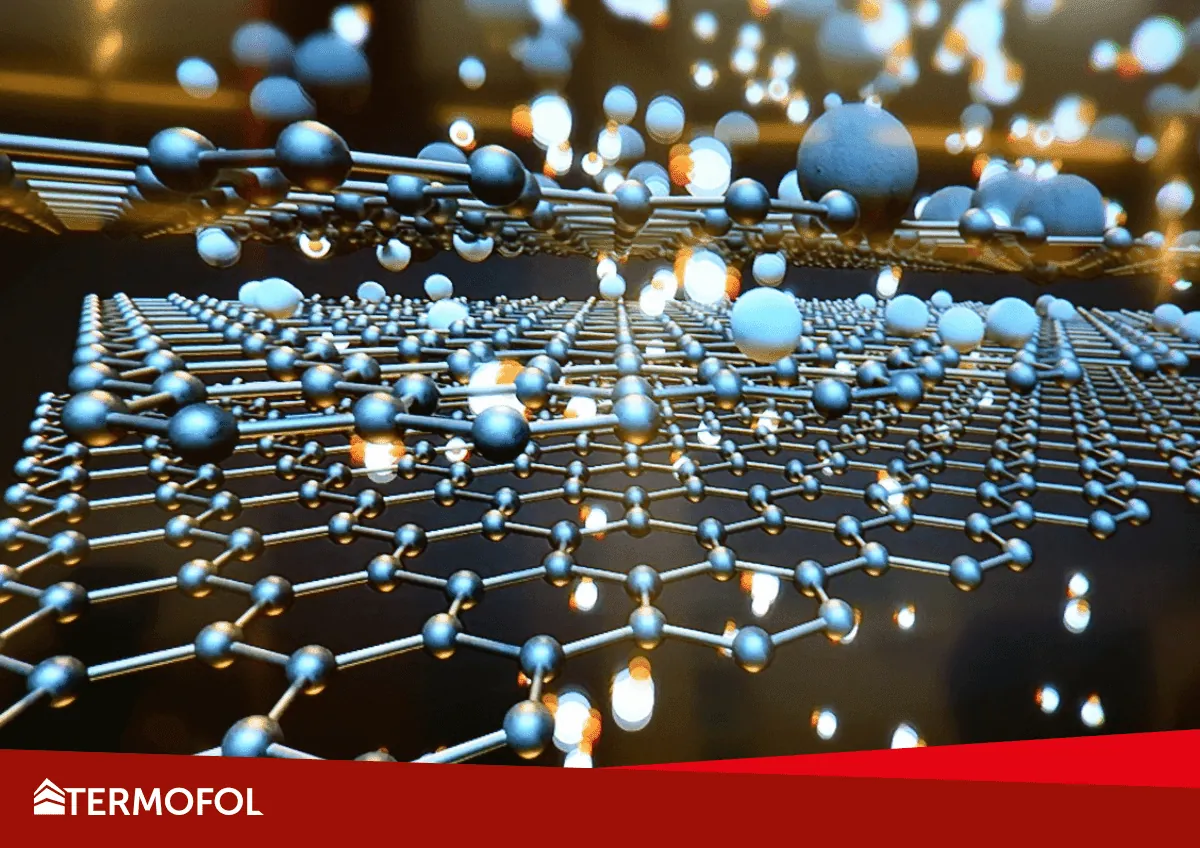
 General information