Hysteresis is a parameter that defines the difference between the set (desired) temperature value and the temperature value at which heating will restart. Anyone who has independent heating should know not only what hysteresis is but also how to set it. Understanding hysteresis can not only improve your heating comfort but also save on heating costs.
Why do I need hysteresis?
The ideal heating system is one that is both efficient and economical. In simple terms, it should provide adequate thermal comfort without draining the household budget. The operating costs of heating are increasingly being considered by investors. The heating system we choose will serve us for the next several years, so we want its operation to be affordable.
Hysteresis is the difference between the temperature desired by the household members and the temperature at which the system should turn back on. Simply put, it is a parameter that determines when the heating system should automatically turn on and when it should turn off.
If you set the hysteresis too high, it can cause temperature fluctuations. These, in turn, will drastically reduce heating comfort. If you set it too low, the heating system will turn on too often. This leads to negative effects in the form of faster wear of the thermostats.
How to set hysteresis?
Hysteresis is a parameter that can be freely adjusted from the thermostat. Thermostats equipped with a Wi-Fi module allow for changing the hysteresis value also from the app. Thus, it can be set by almost anyone who has access to the thermostat or the app connected to the thermostat. Each thermostat has a default hysteresis setting. In Termofol thermostats, it is usually set to 0.5 or 1⁰C.
However, it is advisable to set it manually, as this will translate into optimal operation time for the underfloor heating. This, in turn, will lead to lower heating bills. The system will operate more efficiently because it will not turn on unnecessarily.
Smaller temperature fluctuations in the rooms translate to better living comfort and lower heating bills. It is cheaper and faster to make up for heat losses than to heat the room from scratch. For this reason, if possible, hysteresis should be kept as low as possible. This means that the heating system starts more often but works for shorter periods, thus consuming less energy overall.
What should hysteresis be set to?
Buildings have different energy characteristics, and for this reason, each should be approached individually. Moreover, even each room in a house or apartment can have different hysteresis, as they may be used in different ways. However, certain ranges can be assumed. If the system operates in a two-sensor mode, the hysteresis of the air temperature sensor should be set in the range of 0.5-2 degrees Celsius. If only the external sensor is set, the recommended hysteresis value is from 2-4 degrees.
In conclusion
Setting hysteresis can (and should) be done independently. It determines whether it will be too warm or too cold in the house. Hysteresis can be set independently. There is no need to call a professional, as it can be adjusted from the thermostat or the app if the device is equipped with a Wi-Fi module.
See: underfloor heating
 +48 12 376 86 00
  Downloads
  biuro@termofol.pl


 Blog Termofol
 Published: March 24, 2023
  Reading time: 3 minutes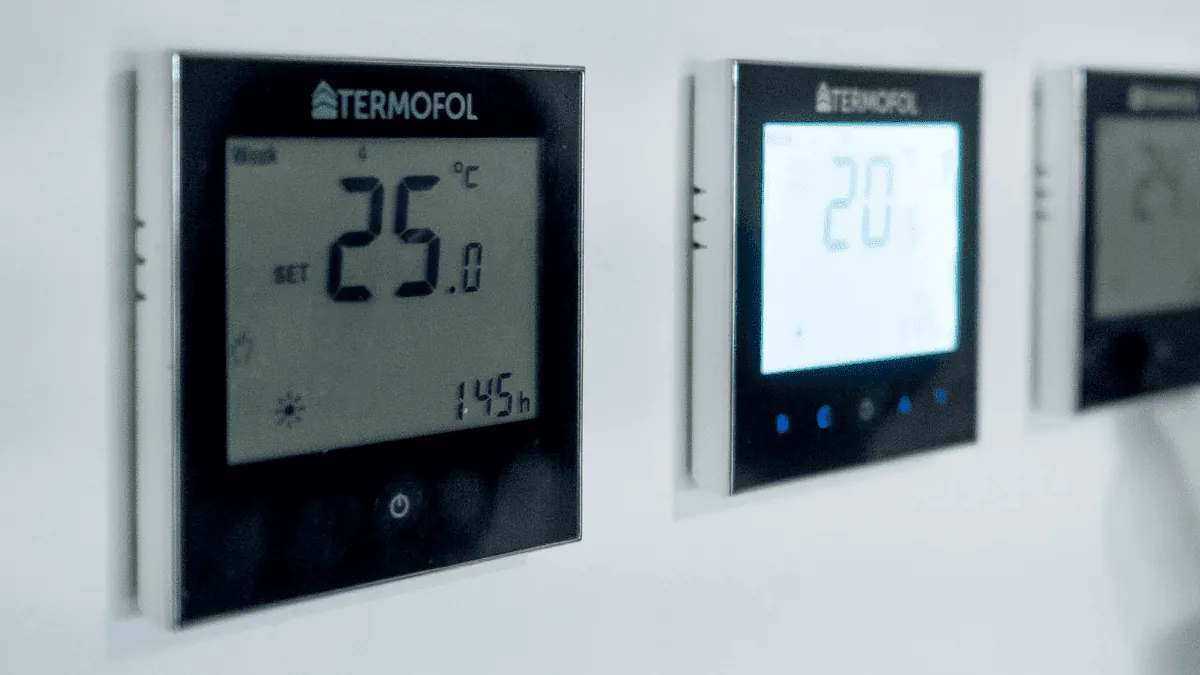
 General information