When creating underfloor heating, one cannot forget about the screed. Without it, the entire installation will not function efficiently. Therefore, it is worth taking a look at the available solutions on the market to make the right choice. The screed for underfloor heating comes in two significantly different versions. We will describe their pros and cons in this article, which we warmly encourage all interested in modern heating systems to read.
Why does underfloor heating need a screed?
Underfloor heating is designed along with the entire building. This is due to the fact that many details related to the operation of the system and the dimensions of the rooms must be taken into account. For example, one must consider how much screed for underfloor heating should be present in a given location. It determines the floor level as well as the thickness of the pipes. Other elements, such as panels or carpets, will then be placed on it. As you can see, this is quite a complicated matter, and everything should be carefully planned already at the design stage of the house.
Since the screed creates the base on which the finish will be placed, it must be applied correctly. First of all, it is important for the surface to be even, which will allow for the installation of the finishing layer. There must not be any thermal bridges due to the formation of air bubbles. The more of these phenomena, the lower the heating efficiency. Thus, the screed for underfloor heating is of great importance for the efficiency of the installation and the aesthetics of the rooms.
It should also not be forgotten that the appropriate thickness of the floor screed protects the pipes from mechanical damage. The number of centimeters that must be present strictly depends on its type. And this is the issue we will focus on right now.
Minimum thickness of screed for underfloor heating using concrete
Cement is one of the most commonly used materials in construction. It is quite universal and, above all, very cheap. However, what is most important in the context of the discussed issue is that it works perfectly as a screed for underfloor heating. However, attention should be paid to several related matters.
Firstly, concrete can be made from ready-made mixtures (available in all building supply stores) or using cement mixed with Portland sand (in a ratio of 3:1). Preparing the material oneself is, of course, cheaper, but it carries the risk of creating concrete with weaker strength parameters. Secondly, the concrete screed for underfloor heating should contain a plasticizing additive. Without it, the surface may become too porous, which will consequently reduce its ability to conduct heat. Finally, it is necessary to ensure moisture removal during the heating of the screed. This takes at least 3 weeks.
And how thick should the concrete layer be? About 6-7 cm is the absolute minimum. A thinner screed is not sufficiently durable and additionally causes improper heat distribution through the pipes of the installation.
What is the thickness of anhydrite floor screed?
A much better material is anhydrite. Why? Because it was created specifically to serve as a screed over underfloor heating. It features self-leveling properties, adheres well to the substrate and heating pipes or cables, and also conducts heat excellently. Simple application eliminates the risk of thermal bridges, which affects heating efficiency. It is also worth emphasizing that anhydrite screed achieves the appropriate hardness after about 2 days, allowing safe walking on it. Finishing work can be carried out after about a week.
The advantages of the material do not end there. In addition, the minimum thickness of the screed for underfloor heating is only 35 mm. As a result, it does not burden the ceiling with unnecessary kilograms, as is the case with traditional concrete. It also does not require any additional reinforcement meshes.
Summary
Currently, the most popular solution is anhydrite screed for underfloor heating. The concrete alternative is used only when the budget severely limits renovation or construction. In such cases, one can expect quite good strength and heat conduction parameters for a reasonable price. However, if one has a bit more money at hand, it is better to opt for anhydrite. The minimum thickness of the screed for underfloor heating is smaller, it dries faster, and provides very good insulation.
We hope this has cleared up any doubts on the subject and will assist in your purchases. If questions arise when creating the heating system (e.g., what should be the thickness of the floor screed in a given situation), we recommend consulting directly with specialists in this field. This is the best way to ensure that the installation will meet the requirements.
 +48 12 376 86 00
  Downloads
  biuro@termofol.pl


 Blog Termofol
 Published: June 27, 2022
  Reading time: 4 minutes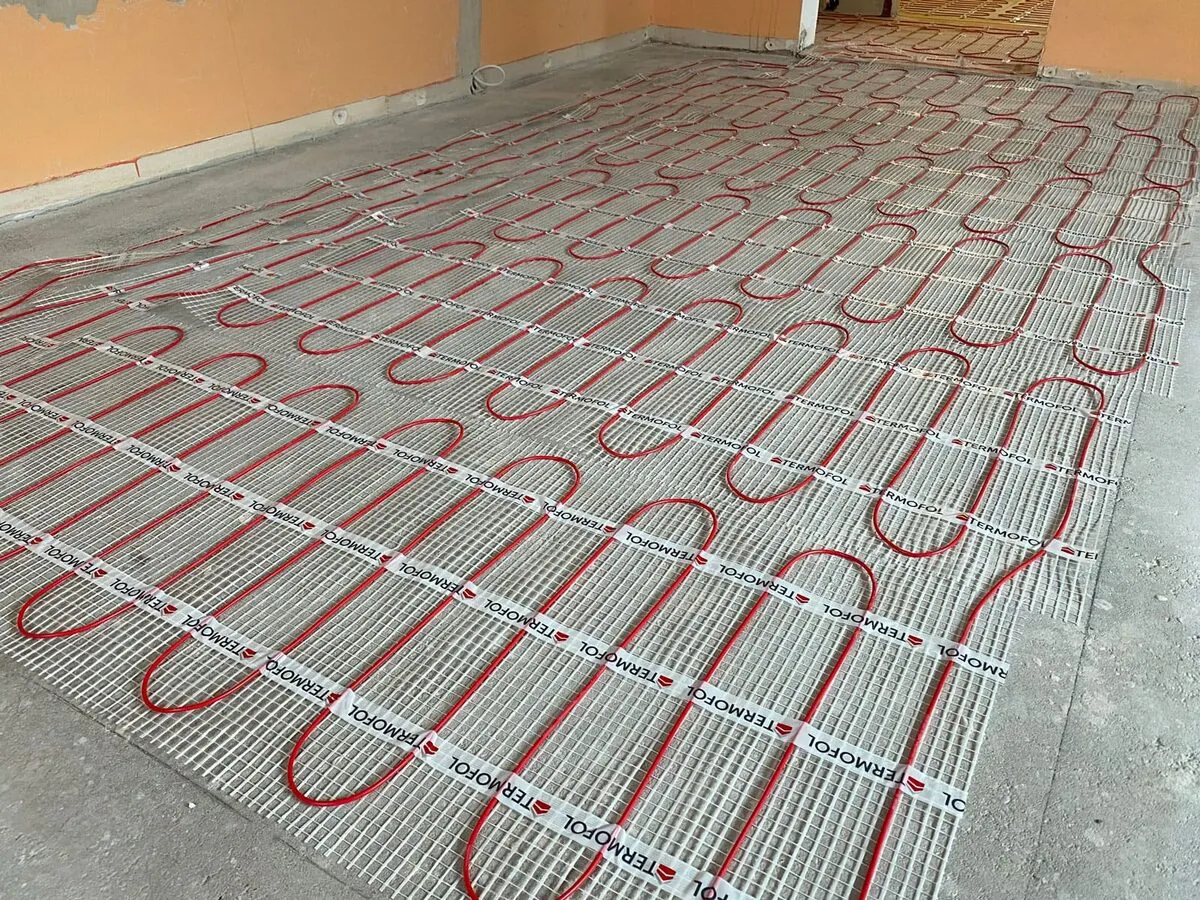
 General information