Choosing the right heating film is a crucial step in designing an efficient and economical electric heating system.
Many investors focus solely on the power of the film, forgetting that the insulation of the building is decisive for thermal comfort and operating costs. Selecting a film with too low power for a poorly insulated building can result in increased electricity bills and insufficient heating.
How Does Heating Film Work?
Heating films are a modern solution for infrared heating, which involves emitting heat in the form of infrared waves. They heat not the air, but objects and surfaces in the room, ensuring an even and comfortable temperature distribution. For the system to operate efficiently, it is crucial to match the appropriate power of the film to the heat loss of the building.
Why Is Building Insulation Crucial?
Thermal insulation affects the amount of energy needed to maintain a comfortable temperature inside the rooms. In poorly insulated buildings, heat escapes more quickly, necessitating the use of stronger heating films to effectively cover heat losses. In modern, well-insulated buildings, films with lower power can be used, leading to savings in operation.
Well-designed building insulation reduces energy losses and makes heating more efficient. Walls, roofs, windows, and floors are key elements that influence the thermal balance of the building. Without proper insulation, even the best heating system will not provide adequate thermal comfort at reasonable operating costs. It is worth remembering that not only the thickness of the insulation matters – the quality of the materials used, their thermal conductivity coefficient (λ), and the tightness of the entire structure are also important.
What film should you choose for a well-insulated building? What heating film should be used in a passive house? Below, we will try to answer these questions.
Choosing Heating Film Depending on Building Insulation
1. Old Buildings – 220 W/m² Films
If the building has poor insulation or is not insulated, the best choice will be heating films with a power of 220 W/m². This solution is suitable for:
- houses built before the 1990s,
- buildings with uninsulated walls and significant heat losses,
- high rooms, where heating the air requires more power.
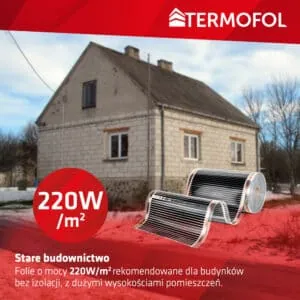
Using a stronger film will maintain adequate thermal comfort even with significant heat losses. However, it is important to be aware that in the case of uninsulated homes, using heating films as the main source of heat will involve relatively high operating costs. It is advisable to consider whether to take advantage of programs offering funding for investments related to the thermal modernization of the house and the installation of modern heat sources.
2. Buildings After Thermal Modernization – 140 W/m² Films
If the building has undergone thermal modernization, meaning it has been insulated with polystyrene or mineral wool and has energy-efficient windows installed, an appropriate choice will be films with a power of 140 W/m². They are recommended for:
- buildings with insulated walls,
- houses after window replacement,
- apartments in blocks modernized for thermal efficiency.
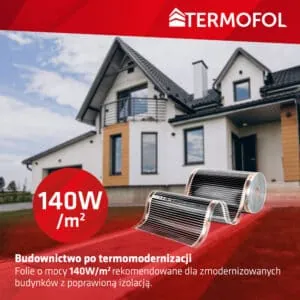
With improved thermal insulation, it is possible to use films with lower power without losing thermal comfort.
3. New Buildings – 80 W/m² Films
Modern homes that meet energy efficiency standards (e.g., WT2021) can use films with a power of 80 W/m². Such films are suitable for:
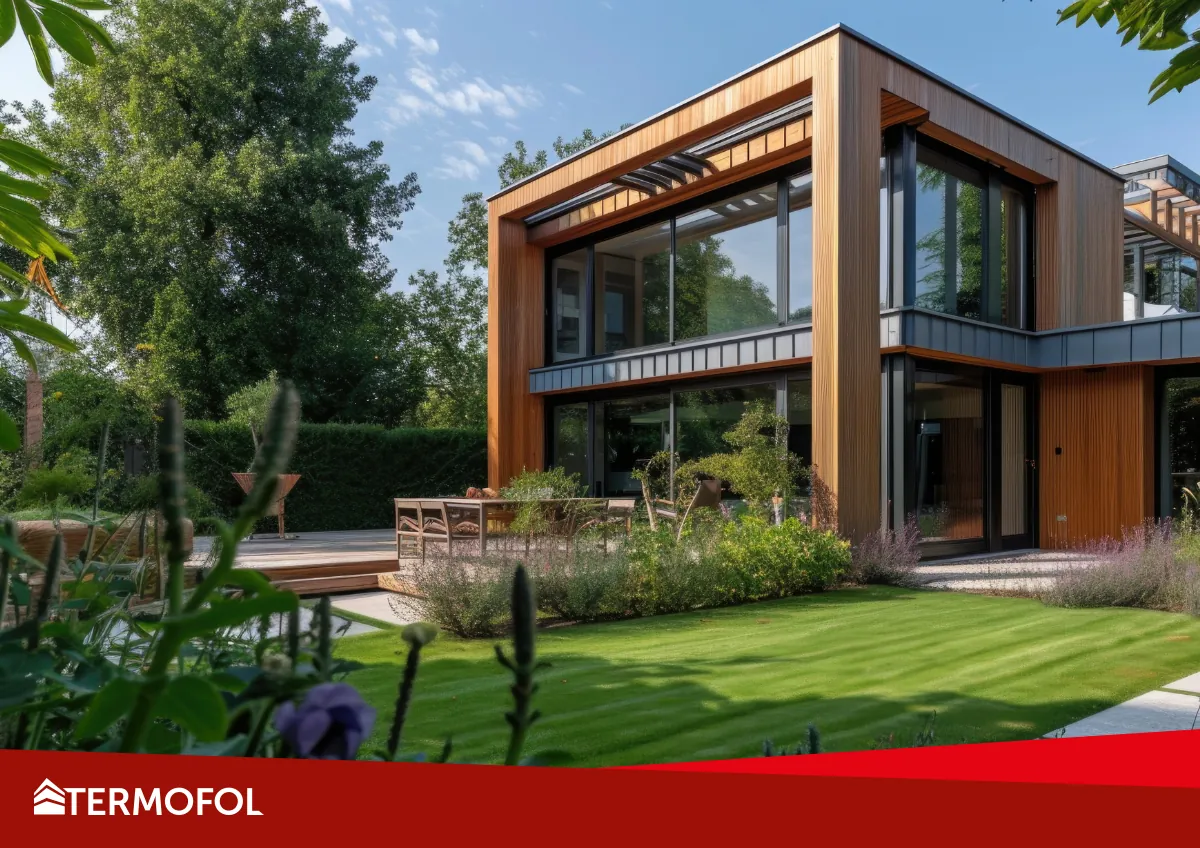
- new single-family homes with good insulation,
- buildings with low energy demand,
- interiors with underfloor heating, where heat is evenly distributed.
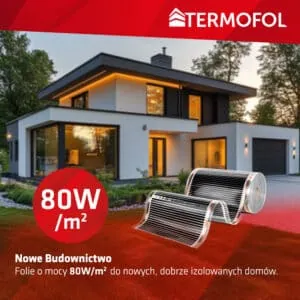
Lower heating power demand means lower operating costs, and by using films with the appropriate power, we avoid overheating and unnecessary energy consumption.
4. Passive Houses – 60 W/m² Films
The most energy-efficient buildings, known as passive houses, can use heating films with a power of 60 W/m². Such buildings consume minimal amounts of energy for heating (below 15 kWh/m² per year). The 60 W/m² film:
- provides the comfort of warm floors,
- allows for maximum energy savings,
- is effective in homes with mechanical ventilation and heat recovery.
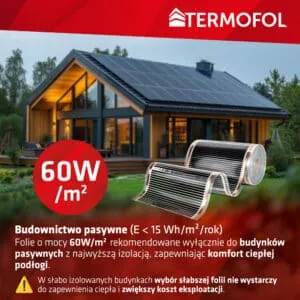
Passive houses are characterized by exceptionally good thermal insulation, high-quality triple-glazed windows, and construction tightness, which minimizes heat losses. In such conditions, heating can be provided even by low-temperature systems, and films with a power of 60 W/m² perfectly fulfill their function, ensuring optimal thermal conditions with minimal energy consumption.
Choosing the right heating film is not only a matter of power but primarily of adapting it to the building's insulation. The better the thermal insulation, the lower the power of the film required. Therefore, before purchasing, it is worth analyzing:
- the type of building and its insulation,
- the level of heat loss,
- the energy demand for heating.
A well-chosen heating film will optimize operating costs and ensure thermal comfort for many years.
IMPORTANT: In poorly insulated buildings, choosing a weaker film will not be sufficient to provide warmth and will increase operating costs.
IMPORTANT: It is advisable to consult the planned power of the film with a TERMOFOL specialist – they will advise on the best solution for the given building and prepare a detailed project of the entire system considering the building's energy efficiency level. A ready, free project will include the exact amount of film, thermostats along with their specifications.
 +48 12 376 86 00
  Downloads
  biuro@termofol.pl


 Blog Termofol
 Published: February 10, 2025
  Reading time: 5 minutes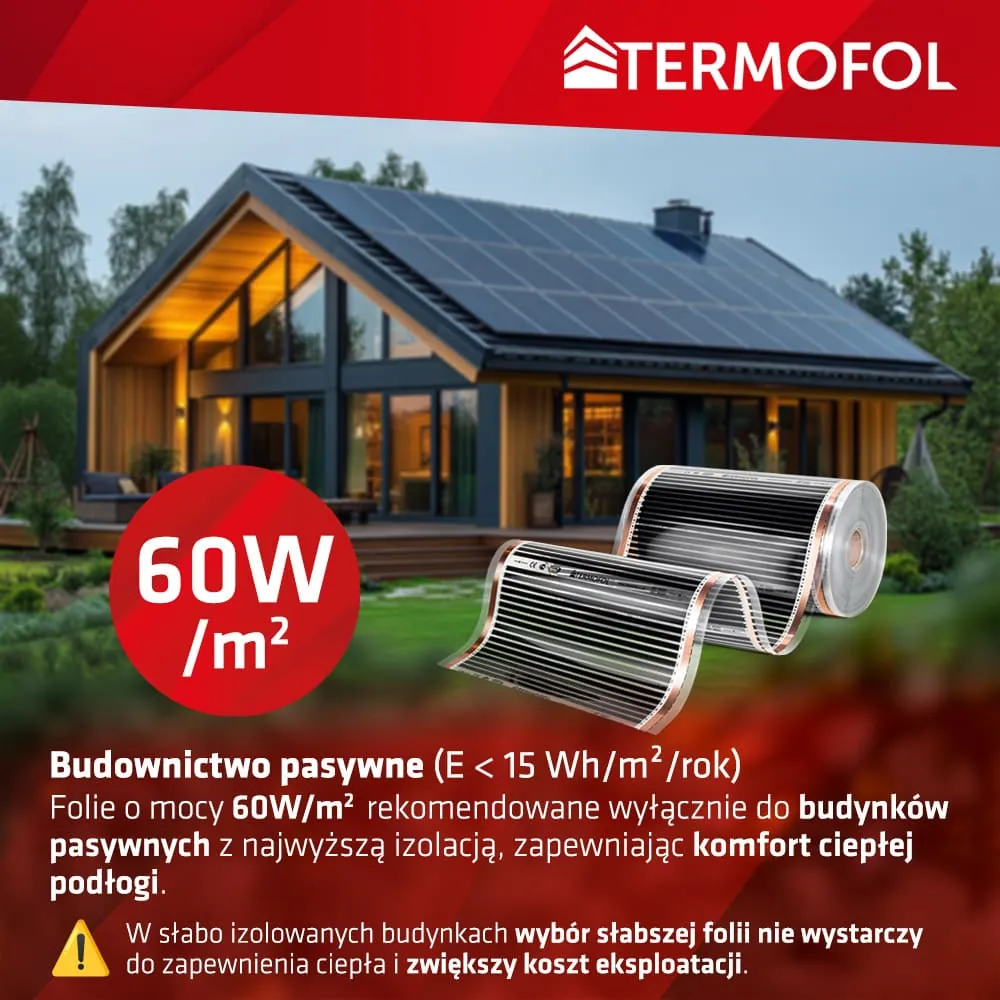
 General information