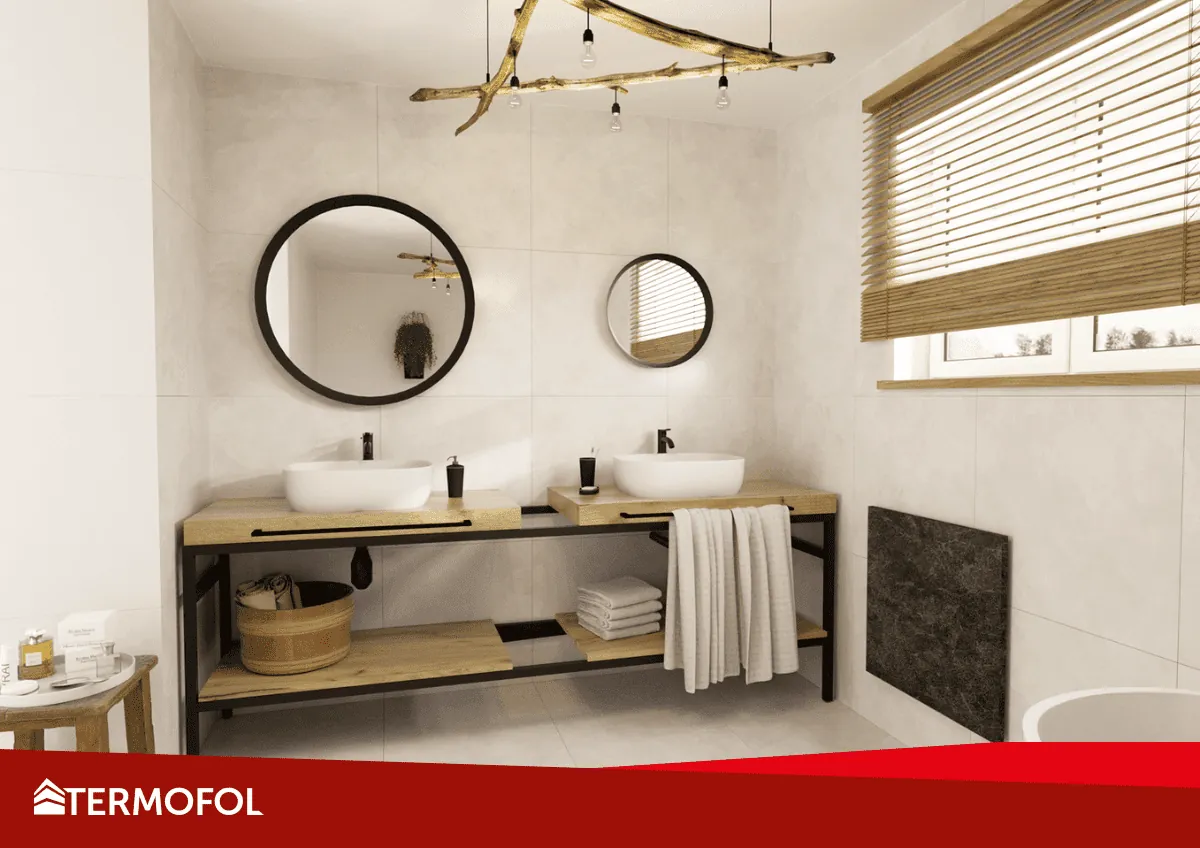
High rooms are extremely fashionable, but at the same time difficult to heat? With standard radiator heating, there can indeed be a problem maintaining the right temperature in a high living room. This issue can be resolved by opting for ceiling heating, wall, floor heating, or a hybrid system combining these solutions. How to heat a high living room? We have some tips!
In recent years, loft-style living rooms with open spaces and high ceilings have become fashionable. Apartments in tenement houses with ceilings over 300 cm high have also returned to favor. The aesthetic qualities of such premises are undeniable. However, a problem arises during the heating season. In high rooms where classic wall heating with hanging radiators is used, maintaining a stable temperature is quite a challenge and sometimes proves completely impossible. A solution that allows you to enjoy a unique interior appearance and optimal heating is wall, floor, and ceiling heating. When it comes to electric wall heating, a large living room is an excellent place for its installation.
Thermal modernization is not enough
Many people, wanting to "heat up" a high living room, focus on properly insulating the interior. This involves eliminating thermal bridges, such as drafty windows, poorly executed thermal insulation of the building's walls or roof. External doors are also replaced, ceilings and floors are insulated. Such solutions do promote heat savings, but they do not eliminate the problem of heating a room with a high ceiling. What to do in such a situation? Apply proven solutions, such as floor heating in the living room.
Wall heating – a living room with a high ceiling
It happens that in a high living room, despite constant heating, a chill is still felt. This occurs due to the convection of heated air, or the "escape" of warm air to the top of the room. As a result, the heat emitted by wall radiators "travels" to a height where it does not benefit the household members. Instead of traditional wall-mounted radiators, which are placed pointwise, it is better to use a mixed heating system, such as floor heating and additionally surface wall heating. In this latter case, heating films (hidden under drywall) can be used in areas where household members often stay. These include, for example, the vicinity of the relaxation area with sofas or the dining area with a table and chairs.
How to heat a high living room? Floor heating
The best solution for high interiors is floor heating. A living room where heating films or mats are installed under the floor guarantees a higher perceived temperature. With floor heating, heat spreads differently than with hanging radiators because heat is emitted over the entire surface of the floor rather than pointwise. The highest temperature is at the floor level and gradually decreases with height. Importantly, in the case of floor heating, heating mats emit a lower temperature than wall radiators. It usually hovers around 27-29 degrees Celsius.
How to heat a high room? Ceiling heating
Are you thinking about installing ceiling heating in a high-ceiling living room? That’s definitely a good idea. Low-temperature surface heating made using heating mats works well not only on the floor but also on the ceiling of a high living room. Why? There are no obstacles on the ceiling blocking the heat emission, such as furniture (as is the case with floor heating or wall radiators). The heat emitted by heating mats is initially directed downwards, ensuring an even distribution of heat vertically. This solution has many advantages, including the ease of regulating the temperature emitted by the heating mats, which is important for users. To achieve a satisfactory effect in a high living room, it is usually necessary to use ceiling heating along with an additional heat source, such as floor and/or wall heating.
Are you wondering how to heat a high room? Do you want to install floor, wall, or ceiling heating? Contact us! We will advise you on the best solution for your high living room.
Check out the ceiling heating panel.
 +48 12 376 86 00
  Downloads
  biuro@termofol.pl


 Blog Termofol
 Published: June 27, 2022
  Reading time: 4 minutes
 General information