Are you wondering how to install a heater in your home or office? Its location is crucial for maximizing efficiency and ensuring proper thermal comfort in the room. Find out where to best place the infrared heater and what mistakes to avoid!
What is an infrared heater? Introduction to the topic
Infrared heaters are an innovative solution in the field of heating systems, offering energy efficiency and thermal comfort at an unprecedented level. By utilizing infrared radiation to directly heat objects rather than air, these devices provide even heat distribution, avoiding issues related to dust or allergen circulation.
How does an infrared heater work?
Radiators operate by emitting infrared waves that directly heat objects and people in the room. As a result, the heat they emit can be felt just a few minutes after turning the device on.
As mentioned, the choice of location for the infrared heater can significantly impact thermal comfort and energy efficiency in your home. The distance of the heater from the wall and the height of the heater from the floor are additional considerations for users wanting to fully utilize the potential of this technology. Therefore, we provide tips on how to position the infrared heater to ensure that the system operates correctly.
How to position the infrared heater? Tips from TERMOFOL
The infrared waves emitted by the heater reach exactly where they are directed. This can be compared to the operation of a regular lamp. If you hang it above a table, only that table will be illuminated. Understanding this mechanism will help you place the infrared heater in a location that meets all your needs.
Correct positioning of the heater – basic rules
Before we discuss in detail the correct positioning of the heater, pay attention to a few "iron" rules regarding the installation of infrared radiators.
- Install the heater where people are. Traditional convection heaters are usually installed under windows to utilize natural air flow and temperature differences. This operates on a very simple principle. Cool air is drawn in from the bottom of the device, heated, and then rises. In contrast, infrared heaters operate by radiating heat that reaches exactly where it is directed, much like light. The wavelength is similar to visible light.
- Do not obstruct the heater. The heater should be positioned so that the infrared rays can freely reach the area they are meant to heat. This means that the device should not be blocked by furniture or other objects that could interfere with the flow of radiation. Firstly, such a location blocks the spread of infrared waves, which leads to uneven temperature distribution in the room. Secondly, placing the infrared panel near objects, even a wooden cabinet, can cause overheating and ultimately damage the furniture.
Another question arises. Should the heater be horizontal? Definitely yes, as this position ensures the most even heat distribution.
What should be the height of the heater from the floor?
Since infrared heaters emit heat, meaning they do not directly heat the air, it is recommended to install them at a height where the inhabitants or people in a commercial space are located. For example, if you are comfortably sitting on a sofa or armchair, the panel should be at least 50 cm above the floor. At this height, the infrared radiation from the heater will reach you, providing pleasant and immediate warmth.
Heater opposite the window
Infrared heating panels and hybrid heaters can be installed on the wall opposite the window. In the case of infrared panels, heat loss occurs in a completely different way than with traditional heating solutions. Far infrared waves do not pass through glass in the same way as visible light, meaning that heat is retained in the room.
However, heat loss occurs when the glass absorbs far infrared radiation and then emits it outside. Older windows or those with single panes may have poor insulation, leading to a faster drop in temperature in the room. In small rooms where the distance from the wall opposite the window is less than about 3 meters and where the radiator on the wall is placed directly opposite the window, there may be a slight loss of heating efficiency.
Heater under the window
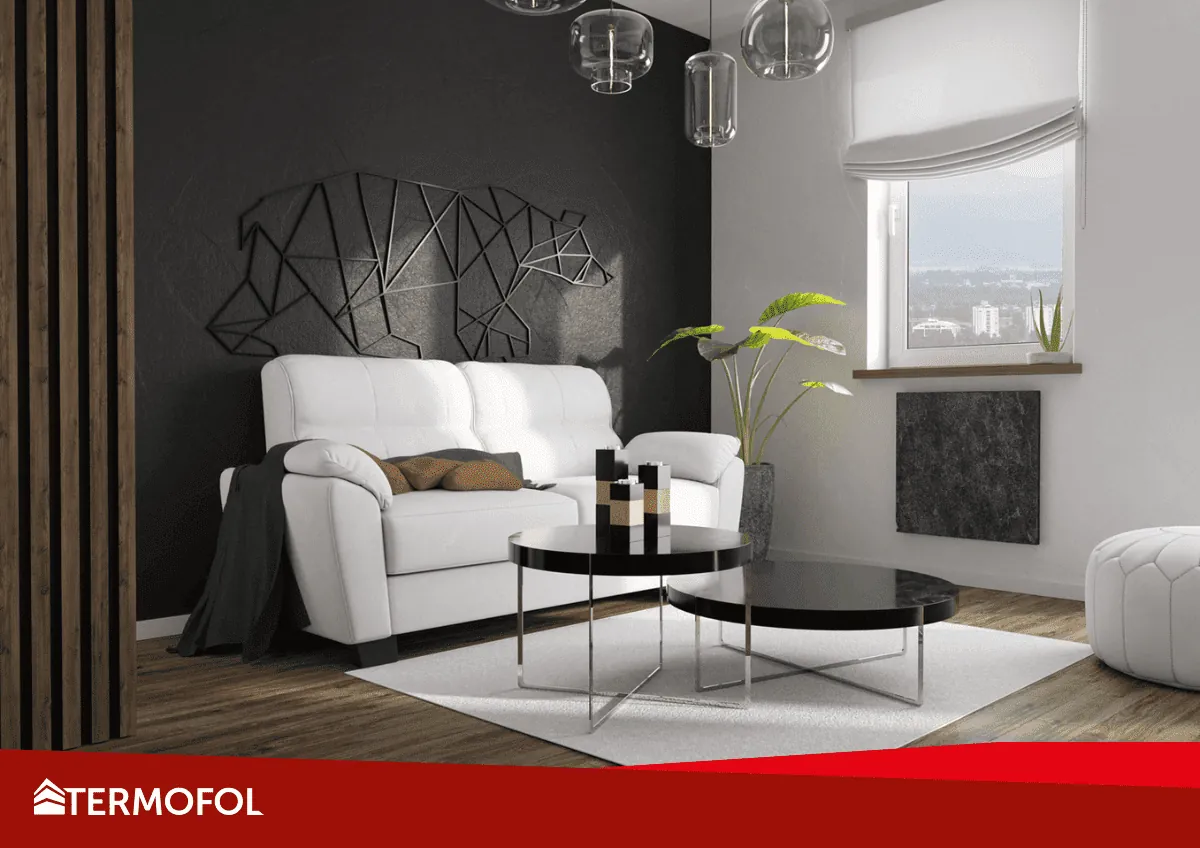
How to position the infrared heater under the window? Can this type of heater under the window replace traditional systems? This solution is possible, but there are several important factors to consider. It is recommended to place it at a height of about 10 to 20 cm above the ground. The infrared panel will operate more effectively in this location than a standard convection heater.
However, it is worth noting that infrared radiators are usually larger than traditional heaters. They therefore have a wider heating surface, which translates to higher energy efficiency.
Heaters in large rooms
When it comes to heating large rooms, it may be necessary to install two or more heaters. This raises the question: how do you know what area an infrared radiator will heat? The greater the power of the device, the larger the area it can heat.
For example, the ceramic heater from TERMOFOL TF-CS500, with a power of 500 watts, is designed to heat a room of 10 m2. In contrast, the TF-CS1000 heater, with a power of 1000 watts, will heat twice the area. Therefore, if you need to provide warmth in a significantly sized room, such as a workspace, the best solution will be to install two or more heaters.
Heaters in atypical rooms
Rooms in attics and lofts often feature slopes and quite irregular surfaces. It may also happen that there is no space on the wall to install a radiator. In such cases, the best option is to install the heater on the ceiling. However, it should be noted that not every device is suitable for this. Our range includes TF-SW350 panels, which are suitable for ceiling installation.
Heater under the window – which one to choose?
Correct positioning of the heater is therefore not only a matter of aesthetics but primarily of operational efficiency. There are many models of infrared heaters available on the market, offering various features such as thermostats, timers, or the ability to control via a mobile app. It is worth familiarizing yourself with all their possibilities, as they guarantee not only convenience but also energy savings.
An example is our TF – SWT 1000 heater, which has a built-in WiFi module. Thanks to this, you can turn on the heating of the room from virtually anywhere in the world. All you need is internet access and the Termofol Smart or Tuya Smart app, depending on which one your device supports.
Another feature to be aware of is the timer. With modern thermostats, you can precisely plan the heating schedule, i.e., at what times heat should be distributed in the room. Don’t forget about the ability to control with a remote. When you install the heater in a hard-to-reach place, such as on the ceiling, the remote will allow you to easily control the heating.
You now know how to install a heater! Ensure warmth in your home with TERMOFOL
Proper placement and installation of infrared heaters are crucial for effective and economical room heating. By remembering the rules for installing infrared heaters mentioned here, you can enjoy comfortable warmth in your home. For more tips and interesting facts, visit our knowledge zone.
At TERMOFOL, we are committed to providing high-quality products and services that not only improve the heating efficiency of your home but also contribute to lowering energy bills. We encourage you to visit our online store or contact our experts for information about our offerings.
Whether you are planning to install a new heating system or want to upgrade an existing one, TERMOFOL is ready to help you enjoy warmth in a sustainable and economical way.
 +48 12 376 86 00
  Downloads
  biuro@termofol.pl


 Blog Termofol
 Published: March 18, 2024
  Reading time: 7 minutes
 Heating