As climate change becomes an increasingly pressing issue, construction is turning to green technologies and innovative solutions. A leading trend in this area is the concept of a passive house. It is not only an effective way to reduce energy bills but also a conscious choice for the planet. In this article, we will learn what a passive house is and why it is becoming an integral part of our future.
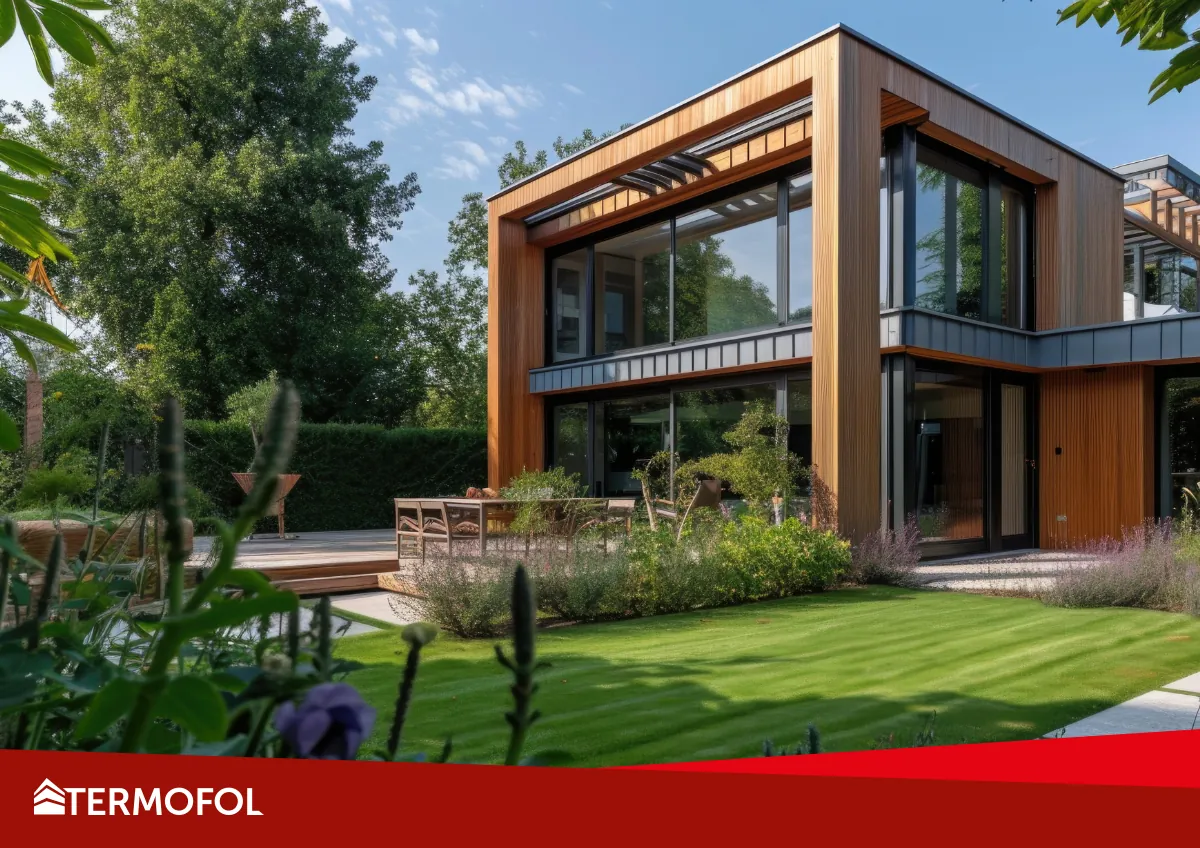
A passive house is a building that actively minimizes its energy demand. Its design and construction are based on the principle of maximum energy efficiency and minimal energy consumption. What does this mean in practice? A passive house can provide comfortable living with minimal energy consumption for heating, cooling, or lighting. What are the main advantages of this innovative approach to construction?
What is a passive house?
A passive house is a building with an extremely low energy demand for heating the interior, amounting to just 15 kWh/m2/year. Thermal comfort in such a house is achieved through the use of passive heat sources, such as:
The above definition provides criteria that must be met for a building to be classified as passive. The criteria for passive houses are also described in the Regulation of the Minister of Infrastructure and Construction of November 14, 2017:
-
The minimum energy demand for heating the house must not exceed 15 kWh/m2/year;
-
The maximum allowable heating power is 10 W/m2;
-
The heat transfer coefficient through external partitions, such as the roof, walls, ceiling, and floor, must not exceed 0.15 W/(m2 * K);
-
The heat transfer coefficient through windows should be 0.8 W/(m2 * K), taking into account the solar energy transmittance coefficient in the range of 50% to 60%;
-
Annual energy consumption must not exceed 120 kWh/(m2 * year);
-
The airtightness of the building, including moisture insulation, should be at least 0.6 l/h;
-
The efficiency of the heat recovery unit (device for recovering heat from the air) must not be less than 75%;
These criteria form the basis for assessing whether a building can be considered passive, while also reflecting the high level of energy efficiency and environmental care characteristic of this type of house.
How much does it cost to build a passive house?
Building a passive house incurs higher costs compared to conventional buildings. So, what amount should one prepare for?
Building a 100-square-meter passive house in a developer's state involves an expense of around 400 thousand zlotys (as of 2023). In the case of building an energy-efficient house to the WT2021 standard of the same size, the costs will be around 350 thousand zlotys, while for a conventional building of similar size, the budget is about 300 thousand zlotys.
It is important to understand that investing in a passive house brings savings in the long term, due to significantly lower energy bills and a smaller impact on the natural environment. Despite the initially higher construction cost, the benefits associated with operating such a house can significantly pay off over time.
Passive house vs. energy-efficient house
These two terms are often used interchangeably. In reality, they are completely different constructions. Passive houses are largely self-sufficient, as they generate energy savings that are more than twice those achieved in energy-efficient buildings.
The differences between these two types of buildings are also visible in their construction. Passive houses typically take on a simple form, as the main goal of the design is to minimize energy consumption. It should be remembered that the more complicated and elaborate the shape, the more so-called thermal bridges it contains.
What are thermal bridges? We wrote about this in the article: “What are thermal bridges? How to combat them? Our advice”
Another significant difference is the type of materials used in construction. Passive houses are characterized by high insulation, which allows for retaining as much heat as possible inside the building. In the case of energy-efficient houses, renewable energy sources are often used. The energy efficiency of passive houses is so high that using renewable energy sources for heating or energy production is not necessary.
What to use for heating a passive house?
In countries where winter is mild, owners of passive houses do not have to worry about heating issues. However, in Poland, winters can still be harsh, so the source of heat is crucial for many people. The high energy efficiency of passive houses makes electric infrared heating the most ideal heating system.
There are several arguments for this, but one of the most important concerns convenience. Infrared systems do not require any human intervention. Properly setting the thermostat allows the owner of a passive house with infrared heating to completely forget that they have any heating system.
Is it worth investing in a passive house?
When considering this issue, one must realize the direction of policy that the European Union has taken some time ago. Through various programs and initiatives, the EU encourages member states to invest in environmentally friendly construction and adopt energy-saving standards. This can be achieved, among other things, by installing photovoltaic panels and modernizing existing buildings towards passivity or reducing their energy demand.
A prime example is the net-billing photovoltaic settlement system, which focuses on so-called distributed energy and self-consumption of the acquired electricity. Passive houses are another step by the EU towards the “Fit for 55” policy adopted by the member states of the Community. For ordinary citizens, this means that in the near future, all newly built houses will have to be passive. Therefore, it is worth building a passive house today, as it may be much more expensive later.
 +48 12 376 86 00
  Downloads
  biuro@termofol.pl


 Blog Termofol
 Published: October 2, 2023
  Reading time: 5 minutes
 General information